Email Verification vs Email Warmup: What's the Difference?
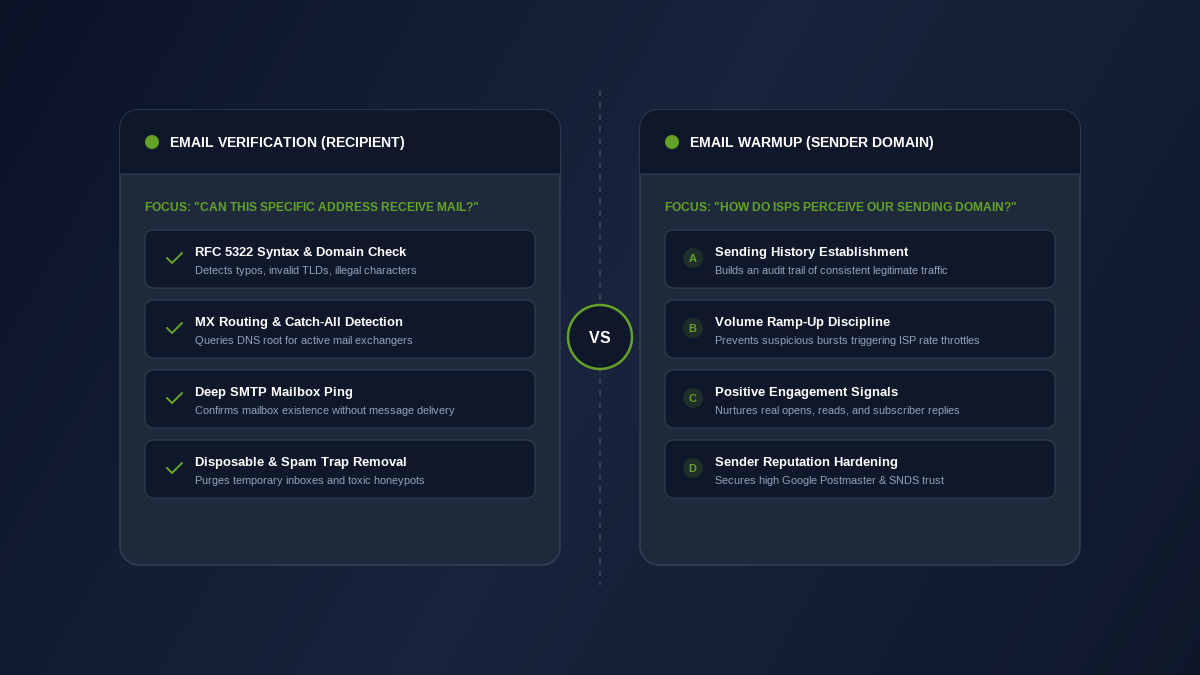
Direct Answer: Email verification inspects the recipient's email address before you send to confirm the mailbox exists, has valid DNS MX routing, and can accept messages. Email warmup establishes trust for the sender's domain and IP address with mailbox providers by gradually scaling volume over several weeks. Verification ensures you have clean data; warmup ensures destination servers trust your identity.
Side-by-Side Comparison
| Attribute | Email Verification | Email Warmup |
|---|---|---|
| Target Analyzed | The Recipient (the contact on your mailing list) | The Sender (your domain, IP, and mail server) |
| Primary Goal | Prevent hard bounces, eliminate typos, strip spam traps | Establish positive reputation with Google, Microsoft, and Yahoo |
| How It Works | DNS lookup, RFC syntax validation, simulated SMTP handshake | Gradual volume pacing, consistent cadence, high subscriber engagement |
| Execution Timeline | Instantaneous (sub-400ms per address or bulk batch) | Multi-week process (typically 2 to 6 weeks) |
| Impact on Deliverability | Keeps bounce rate under 1%, avoiding ISP penalties | Builds historical sender authority to reach the Primary Inbox |
What Email Verification Actually Does
An enterprise email verification engine like Emails Verification performs a sequence of non-intrusive diagnostic checks:
- Syntax Validation: Confirms the address strictly adheres to RFC 5322 formatting standards.
- DNS & MX Resolution: Queries root DNS servers to confirm the recipient domain exists and possesses active Mail Exchanger records.
- SMTP Socket Handshake: Initiates an RFC-compliant SMTP socket connection to the target mail server (sending
HELO,MAIL FROM, andRCPT TO) to confirm mailbox existence, disconnecting before transmitting message data. - Risk Analysis: Identifies disposable burner emails, toxic honeypots, and generic role accounts (e.g.
info@,admin@).
What Email Warmup Actually Does
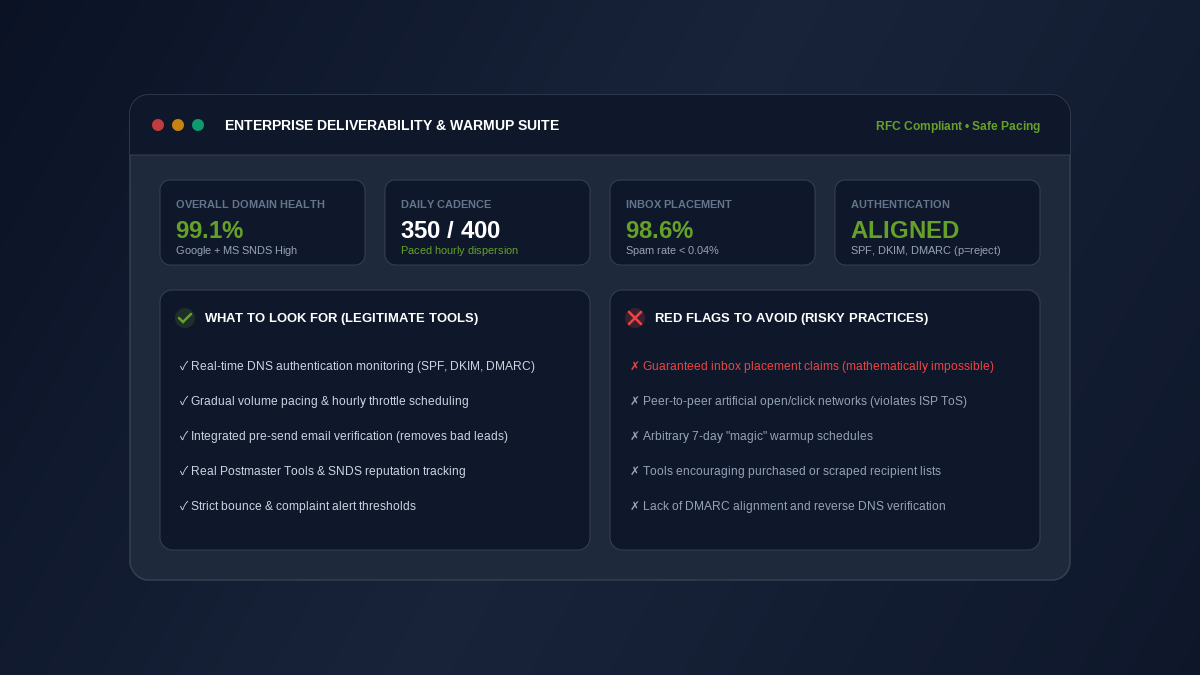
Email warmup is the operational practice of introducing a new or cold sending domain to destination mailbox providers. Because mailbox algorithms treat unknown domains with suspicion, warmup establishes a steady history of legitimate sending behavior. Learn the exact process in our guide on How to Warm Up an Email Domain.
Invalid, Disposable, Catch-All, and Role Categories
A comprehensive verification engine classifies addresses into distinct actionable categories:
- Deliverable (Valid): Verified active mailbox with confirmed SMTP recipient acceptance. Safe to mail.
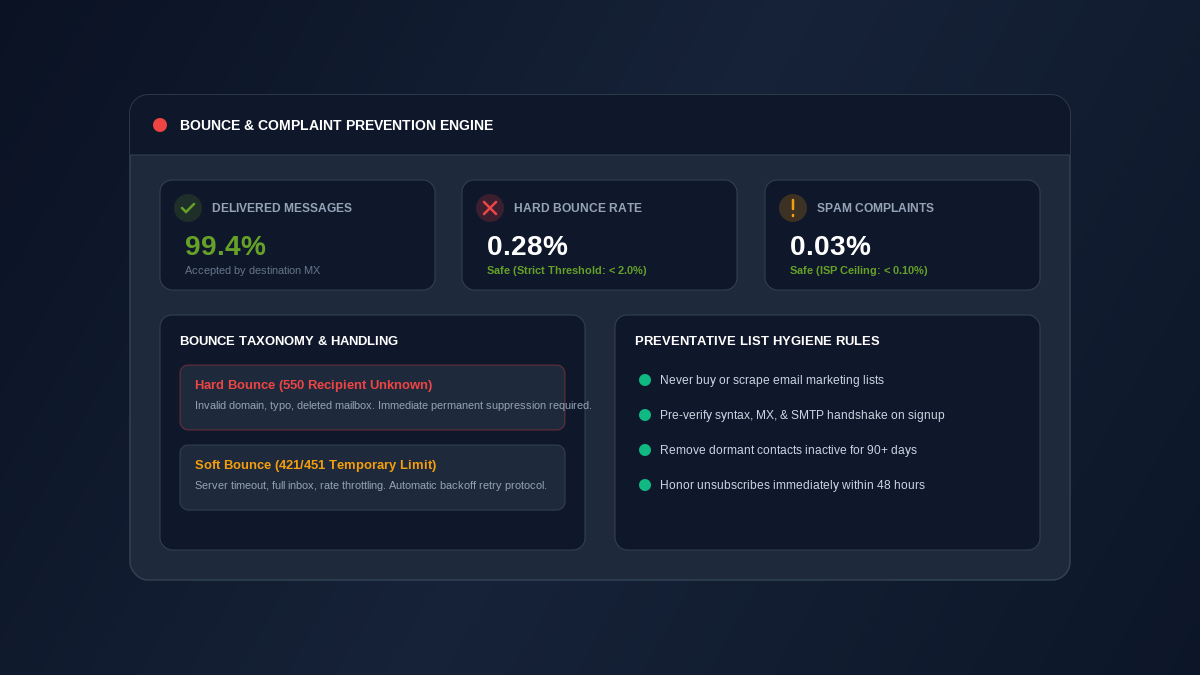
- Invalid (Undeliverable): Dead address, typo, or deleted account. Sending will trigger a hard bounce.
- Disposable: Temporary burner accounts (e.g. Mailinator, Temp-Mail) created to bypass forms. Should be removed.
- Catch-All (Accept-All): Mail servers configured to accept any incoming message regardless of whether the user exists. Requires careful handling.
What Email Verification Cannot Do
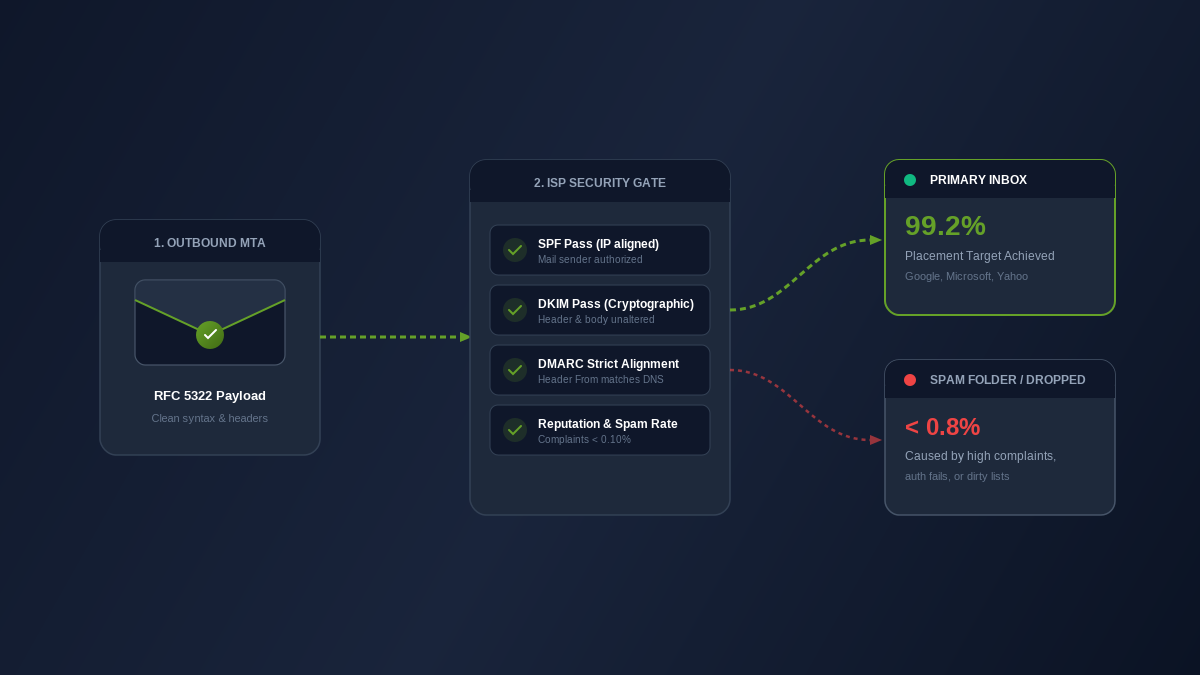
- It cannot guarantee inbox placement: Even if an address is 100% deliverable, your message will land in spam if your sending domain has poor reputation or fails DMARC.
- It cannot prove consent: Verification does not confirm that the recipient wants your marketing or opted into your list.
What Email Warmup Cannot Do
- It cannot turn a dead mailbox into an active one: If your list is filled with invalid addresses, warming up your domain will not prevent hard bounces.
- It cannot bypass spam filter penalties: Warmup cannot save a domain that generates excessive spam complaints.
How Both Disciplines Work Together
Email verification and email warmup are complementary, non-negotiable halves of a professional deliverability strategy:
Step 1: Run your entire contact database through Emails Verification to strip out invalid mailboxes, disposable addresses, and syntax errors.
Step 2: Use the clean, deliverable contact list to execute your progressive domain warmup timeline. Because your bounce rate will remain below 0.5%, mailbox providers will smoothly increase your domain trust.
Start with Verified Data Before You Warm Up
Verify up to 100 emails for free. Our engine validates syntax, checks DNS MX routing, and simulates deep SMTP handshakes in under 400ms without sending a message.
Claim 100 Free Verification Credits ➔Frequently Asked Questions
Can email warmup fix the deliverability of an unverified list?
No. Warming up a sending domain does not make invalid email addresses valid. If you send warmup emails to bad data, the resulting hard bounces and spam traps will immediately destroy your newly established reputation. You must verify recipient data before initiating warmup.
Does email verification prove that a recipient gave consent to receive marketing?
No. Email verification only proves technical feasibility: that the address is syntactically valid and the mail server accepts messages. It does not prove recipient consent, opt-in status, or interest. Senders must still follow applicable privacy laws (such as GDPR and CAN-SPAM).
Should I verify my contact list before or during email warmup?
Always before. Verifying your list before initiating domain warmup ensures that every single email dispatched during the delicate warmup phase lands in a real, active mailbox, preventing fatal hard bounce spikes.